


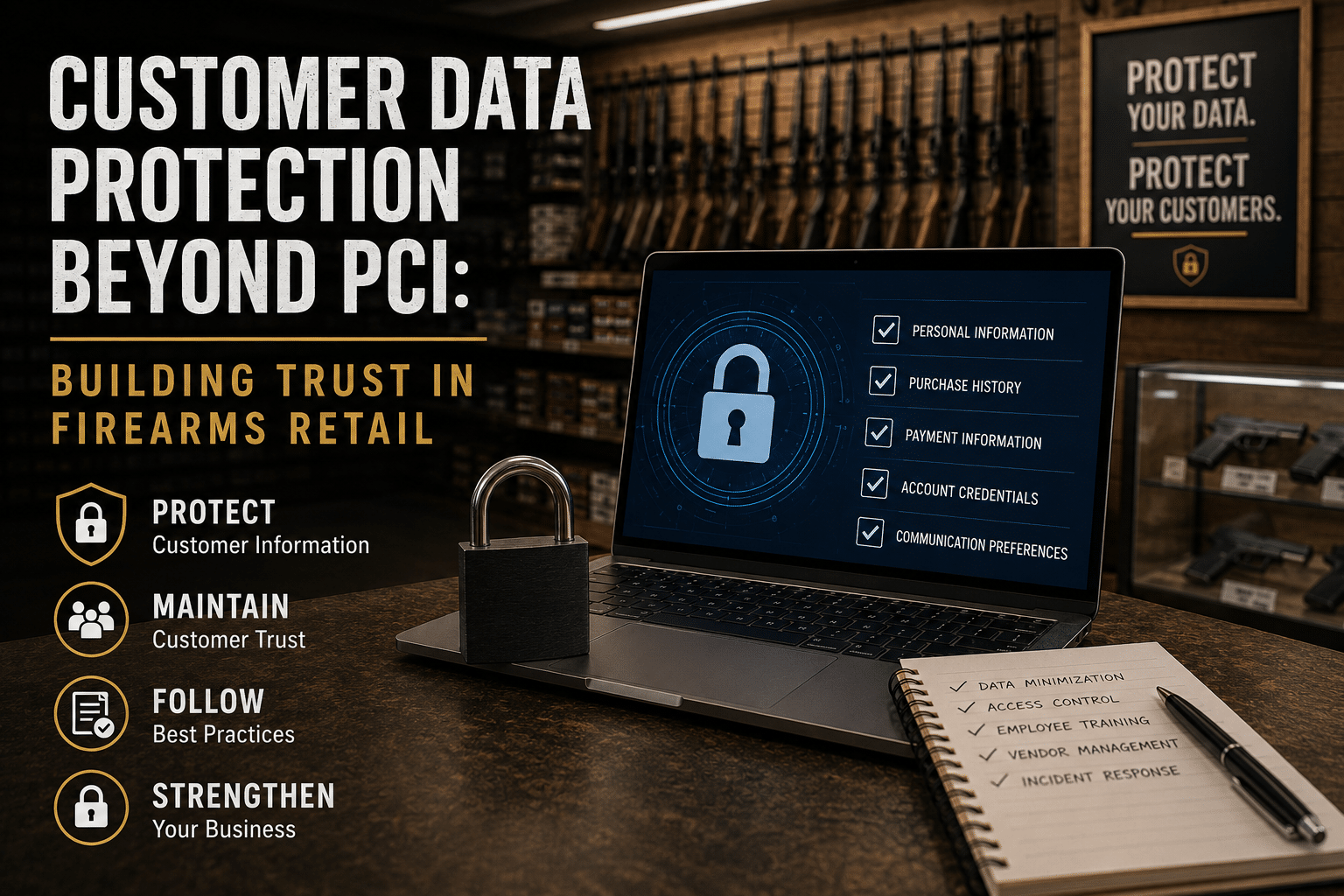
Most business owners have heard of PCI compliance. Payment Card Industry (PCI) standards are an important part of protecting payment information and maintaining secure transaction environments.
However, many retailers make the mistake of assuming that PCI compliance alone is enough to protect their business.
The reality is that customer trust extends far beyond payment card data.
Firearm retailers often collect a wide range of information during the course of normal business operations. Customer names, contact information, purchase histories, online account credentials, training registrations, loyalty program details, and other sensitive information may all be stored across multiple systems.
Protecting this information is not just a technology issue. It is a business issue.
Customers expect businesses to handle their information responsibly. Retailers that prioritize data protection can strengthen trust, improve customer relationships, and reduce operational risk.
Why Customer Trust Matters
Trust is one of the most valuable assets any business can possess.
Customers choose where they shop based on many factors, including:
- Product selection
- Pricing
- Expertise
- Convenience
- Reputation
Trust influences all of these decisions.
When customers believe a retailer operates professionally and responsibly, they are often more comfortable making purchases, joining loyalty programs, signing up for training events, and engaging with the business long-term.
Protecting customer information helps reinforce that trust.
Understanding the Types of Data You Collect
Many retailers underestimate how much customer information they actually maintain.
Examples may include:
Contact Information
Names, addresses, email addresses, and phone numbers.
Transaction Records
Purchase histories and customer preferences.
Ecommerce Accounts
Login credentials, order histories, and account activity.
Marketing Information
Email subscriptions, loyalty programs, and promotional preferences.
Training and Event Registrations
Participant information and scheduling details.
Each category introduces responsibilities regarding storage, access, and protection.
Data Protection Is More Than Cybersecurity
When people hear the phrase “data protection,” they often think exclusively about hackers.
Cybersecurity is certainly important, but it is only one component.
Data protection also includes:
- Employee access controls
- Physical security
- Device management
- Vendor oversight
- Record retention policies
Many breaches occur because of simple operational weaknesses rather than sophisticated cyberattacks.
Strong processes often provide just as much value as advanced technology.
Limiting Data Collection
One of the simplest ways to reduce risk is to collect only the information that is actually needed.
Every piece of customer information stored by a business becomes something that must be protected.
Before collecting new information, retailers should ask:
- Is this information necessary?
- How will it be used?
- How long will it be retained?
- Who needs access to it?
Reducing unnecessary data collection can significantly reduce exposure.
Managing Employee Access
Not every employee requires access to every system.
Role-based access controls help ensure employees can only access the information necessary to perform their responsibilities.
Examples may include:
- Sales associates
- Managers
- Inventory personnel
- Marketing staff
- Accounting teams
Restricting access helps reduce both accidental and intentional misuse of customer information.
It also simplifies oversight and accountability.
Password Security and Authentication
Weak passwords remain one of the most common security vulnerabilities.
Businesses should encourage:
- Strong password requirements
- Unique passwords for each system
- Multi-factor authentication where available
- Regular credential reviews
These practices significantly reduce risk while requiring relatively little investment.
Small improvements often provide meaningful security benefits.
Protecting Customer Information Across Multiple Systems
Modern retailers often use multiple technology platforms simultaneously.
Examples may include:
- Ecommerce platforms
- Point-of-sale systems
- Email marketing tools
- CRM platforms
- Inventory software
Each system introduces potential vulnerabilities.
Retailers should understand:
- What information is stored
- Where information is stored
- Who has access
- How vendors protect data
Visibility is essential for effective management.
Vendor Due Diligence
Many businesses rely heavily on third-party providers.
These vendors may manage:
- Ecommerce transactions
- Email marketing
- Cloud storage
- Customer communications
- Software platforms
Retailers should evaluate vendors carefully before sharing customer information.
Questions worth asking include:
- What security practices are in place?
- How is information stored?
- What happens if a breach occurs?
- How are access controls managed?
Strong vendor relationships begin with clear expectations.
Employee Training and Awareness
Technology alone cannot solve security challenges.
Employees play a critical role in protecting customer information.
Training should address:
- Password management
- Phishing awareness
- Device security
- Customer information handling
- Reporting procedures
Well-informed employees often serve as the first line of defense against security incidents.
Regular education helps reinforce good habits.
Preparing for Security Incidents
No business can eliminate risk entirely.
Preparation matters.
Retailers should establish procedures for responding to potential security incidents.
Plans may address:
- Internal reporting
- Vendor notification
- Customer communication
- System reviews
- Recovery procedures
Organizations that prepare in advance often respond more effectively when challenges arise.
Physical Security Still Matters
Digital security receives significant attention, but physical security remains important.
Businesses should evaluate:
- File storage practices
- Device security
- Access controls
- Surveillance systems
- Visitor management
Sensitive information should not be left exposed unnecessarily.
Simple physical safeguards can prevent many avoidable problems.
Building Customer Confidence
Customers increasingly care about how businesses handle their information.
Retailers can build confidence through:
- Clear privacy practices
- Professional communication
- Secure technology
- Consistent procedures
Trust develops gradually but can be lost quickly.
Businesses that demonstrate a commitment to protecting customer information often differentiate themselves in meaningful ways.
Creating a Culture of Responsibility
The most successful data protection programs are not built around technology alone.
They are built around culture.
Employees should understand that protecting customer information is part of serving customers well.
When data protection becomes a shared responsibility rather than a specialized task, organizations tend to perform more consistently.
Accountability, awareness, and professionalism all contribute to stronger outcomes.
Protecting Information and Strengthening Relationships
Customer data protection is about more than compliance requirements and security checklists. It is about maintaining trust.
Firearm retailers invest significant effort in building relationships with customers. Protecting the information those customers share is an important part of honoring that relationship.
By limiting unnecessary data collection, implementing sensible access controls, training employees effectively, evaluating vendors carefully, and developing strong operational procedures, retailers can significantly reduce risk while strengthening customer confidence.
In today’s business environment, trust has become a competitive advantage. Businesses that treat customer information responsibly are often rewarded with stronger relationships, increased loyalty, and long-term success.