


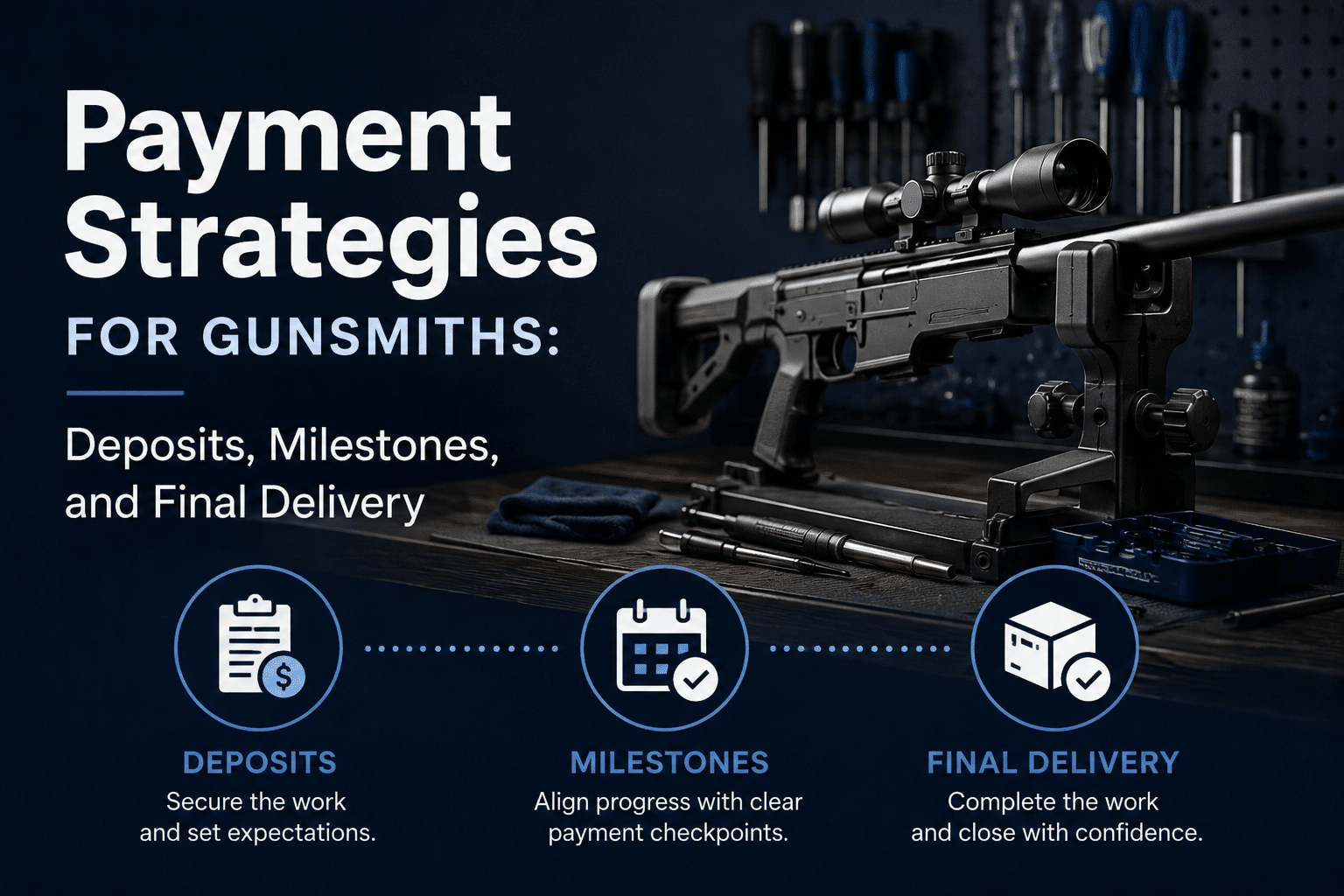
Gunsmithing is one of the most unique business models in the firearms industry. Unlike traditional retail sales, many gunsmith projects involve custom work, long timelines, special-order parts, and customer expectations that can evolve throughout the process. These factors create challenges that standard payment workflows often fail to address.
A firearm retailer can complete a transaction in minutes. A gunsmith may spend weeks or even months completing a custom build, restoration, trigger job, Cerakote application, optic installation, or other specialized service.
Because of these extended timelines, gunsmiths need payment strategies that protect cash flow, reduce disputes, and create clear expectations for customers. A well-designed payment process can improve profitability while minimizing misunderstandings that often lead to chargebacks, refund requests, and administrative headaches.
Why Traditional Payment Models Often Fall Short
Many gunsmiths begin by treating custom work like a standard retail transaction. The customer requests a service, the work is performed, and payment is collected upon completion.
While this approach may work for smaller jobs, it can create significant risk for larger projects.
Consider a custom rifle build requiring specialty components, machining work, coatings, optics installation, and extensive labor. If a customer changes their mind midway through the process, the gunsmith may be left holding inventory that was purchased specifically for that project.
Likewise, if a customer becomes difficult to reach after work has been completed, the shop may find itself carrying labor costs and inventory expenses without a clear path to recovery.
This is why successful gunsmith operations typically use structured payment schedules rather than relying solely on final payment collection.
The Role of Deposits
Deposits serve several important purposes.
First, they demonstrate customer commitment. When a customer provides a deposit, they become financially invested in the project.
Second, deposits help offset upfront costs. Many gunsmith projects require parts purchases before any labor begins. Collecting a deposit ensures that inventory expenses do not come entirely out of the shop’s operating cash.
Third, deposits reduce cancellation risk. Customers are generally less likely to abandon a project when they have already committed funds.
A common approach is to require a deposit equal to the estimated cost of special-order components plus a portion of anticipated labor. The exact amount will vary depending on the project and business model, but the objective remains the same: ensure that the shop is not carrying all of the financial risk.
Creating Clear Deposit Policies
A deposit policy should be documented and communicated before work begins.
Customers should understand:
- How much is required upfront
- What the deposit covers
- Whether the deposit is refundable
- Under what circumstances refunds may be issued
- How changes to the project will be handled
Transparency is essential.
Many disputes occur because customers assume one thing while the business assumes another. Written authorization forms, work orders, and project agreements help eliminate confusion.
Whenever possible, customers should acknowledge these policies in writing before the project begins.
When Milestone Payments Make Sense
Not every project should rely on a single deposit and final payment.
Large custom builds often benefit from milestone-based billing.
Milestone payments divide a project into logical stages and collect payment as progress occurs.
For example:
Stage 1: Project Initiation
- Initial consultation
- Design review
- Parts selection
- Deposit collected
Stage 2: Parts Procurement
- Components ordered
- Specialized materials acquired
- Customer receives status update
Stage 3: Build and Installation
- Machining completed
- Components fitted
- Major labor milestones achieved
Stage 4: Finishing and Testing
- Coating or finishing completed
- Function testing performed
- Final inspections conducted
Stage 5: Delivery
- Final payment collected
- Firearm released to customer
This approach provides several advantages.
The customer gains visibility into project progress while the business improves cash flow throughout the engagement.
Reducing Financial Risk During Long Projects
Long project timelines create unique risks.
Market conditions can change. Parts costs can increase. Supply chain delays may occur. Customers may request modifications after work has begun.
A detailed project agreement should address these possibilities.
Important considerations include:
Change Orders
If a customer requests additional work, document the change before proceeding.
This protects both parties and helps avoid disagreements when the final invoice is presented.
Price Adjustments
Certain projects may require language addressing significant cost increases from suppliers or manufacturers.
Abandoned Projects
Businesses should establish procedures for projects that remain unclaimed after completion.
Consult legal counsel regarding state-specific requirements before implementing abandonment policies.
Communicating Throughout the Process
One of the most effective chargeback prevention tools is proactive communication.
Customers often become frustrated when they do not know the status of a project.
Regular updates can dramatically improve customer satisfaction.
Consider providing updates when:
- Parts are ordered
- Parts arrive
- Major work begins
- Significant milestones are completed
- The project is ready for pickup
Even a brief email or text message can reassure customers that progress is being made.
Communication is especially important when delays occur.
Most customers are understanding when informed early. Problems typically arise when delays happen without explanation.
Managing Final Payment Collection
The final payment stage deserves careful planning.
Some gunsmiths notify customers only after the project is fully complete. Others collect final payment before certain finishing steps or before shipment to another location.
Whatever approach is used, consistency is important.
Final invoices should clearly itemize:
- Labor charges
- Parts costs
- Additional services
- Taxes and fees
- Previous payments received
- Remaining balance due
Detailed invoices improve transparency and help reduce billing disputes.
Documentation Matters
Documentation is one of the strongest defenses against misunderstandings and chargebacks.
Maintain records that include:
- Original work orders
- Customer approvals
- Deposit receipts
- Change orders
- Email communications
- Progress updates
- Completed invoices
- Pickup confirmations
When a customer questions a charge months later, detailed records often provide the evidence needed to resolve the situation quickly.
Handling Refund Requests
Refund requests should be evaluated based on documented policies rather than emotion.
Not every refund request indicates a problem.
However, inconsistent refund decisions can create operational challenges and customer confusion.
A written refund policy should address:
- Deposits
- Special-order parts
- Completed labor
- Project cancellations
- Unclaimed projects
Customers should have access to this information before authorizing work.
The more clearly expectations are established upfront, the fewer disputes arise later.
Technology Can Simplify the Process
Modern payment systems can help streamline project management and billing.
Depending on the business, useful features may include:
- Digital invoicing
- Recurring payment capabilities
- Stored payment profiles
- Secure customer vaulting
- Automated receipts
- Online payment links
- Integrated reporting
These tools can reduce administrative workload while creating a more professional customer experience.
For shops handling multiple projects simultaneously, automation can save substantial time and improve operational efficiency.
Building a Sustainable Gunsmith Business
Successful gunsmithing requires more than technical skill. It also requires sound business processes.
A structured payment strategy protects cash flow, improves customer communication, and reduces the likelihood of disputes. Deposits help cover upfront costs. Milestone billing supports long-term projects. Thorough documentation provides protection when questions arise.
Most importantly, a well-designed payment process creates clear expectations for both the gunsmith and the customer.
As custom firearms work continues to grow in popularity, shops that establish disciplined payment procedures will be better positioned to maintain profitability, manage risk, and deliver exceptional customer experiences.